
The Evolution of the Clubhouse
The traditional clubhouse was designed to support golf. Members arrived shortly before their tee time, played eighteen holes, enjoyed lunch with their foursome and returned home. The restaurant served an important function, but it was rarely considered a destination in its own right.
Today’s clubhouse serves a very different purpose.
Members expect far more from their club than convenient access to great golf. They are looking for a place that naturally fits into their lifestyle throughout the week. A single visit may begin with breakfast before an early tee time, continue with lunch after the round, include a business meeting during the afternoon and conclude with dinner overlooking the golf course as family members arrive to join them.
This evolution has transformed the role of dining within private clubs. Rather than existing alongside the golf experience, hospitality has become an integral part of it. Members increasingly measure the quality of a club not only by the condition of its fairways and greens, but also by the atmosphere of its dining room, the service they receive, the quality of the food and the opportunities the clubhouse creates for meaningful social interaction.
Successful clubs have recognized that every meal represents another opportunity to strengthen the member experience. Every lunch introduces members to new friendships. Every family dinner reinforces traditions. Every celebration held within the clubhouse strengthens the emotional connection people have with the Club itself.
How Private Club Dining Has Changed
| Traditional Clubhouse Dining | Modern Private Club Dining |
|---|---|
| Quick meal after golf | Destination dining throughout the week |
| Primarily golfers | Members, spouses, families and guests |
| Limited clubhouse menu | Chef-inspired seasonal menus |
| Seasonal activity | Year-round social destination |
| Functional restaurant | Hospitality experience |
| Small patio or indoor seating only | Expanded outdoor dining overlooking the golf course |
| Supports golf | Strengthens the entire membership experience |
The changes shown above reflect more than evolving food preferences. They illustrate how private clubs have adapted to changing lifestyles and member expectations. Dining is no longer viewed simply as another amenity. It has become one of the primary ways clubs create lasting value for their members.
Dining Has Become a Reflection of Club Culture
Every private golf club develops its own identity over time. Some become known for championship golf, others for their history or competitive traditions. Increasingly, however, members also describe their clubs through the experiences they share inside the clubhouse.
The atmosphere surrounding a meal often says as much about a club as the condition of its fairways. A welcoming dining room encourages conversations that extend well beyond golf. Members linger over coffee after breakfast, introduce new families to the Club, celebrate birthdays and anniversaries and gather for seasonal events that strengthen the sense of community.
These moments cannot be manufactured through architecture alone, yet thoughtful clubhouse design plays an important role in making them possible. Comfortable seating, natural gathering spaces, attentive service and inviting outdoor patios encourage members to remain at the Club rather than rushing home. Over time, those additional hours become the foundation of lasting friendships and cherished traditions.
Hospitality professionals within the private club industry often describe the restaurant as an extension of the golf experience rather than a separate service. Members rarely think about golf and dining as unrelated activities. They experience them as two parts of the same day, each enhancing the value of the other.
Industry Insight
Private clubs across North America are investing more heavily in food and beverage operations than ever before. Modern clubhouse renovations increasingly prioritize expanded kitchens, flexible dining areas, outdoor patios and year-round gathering spaces because hospitality has become one of the strongest contributors to member satisfaction and long-term retention.
Members Are Looking for Places, Not Just Golf Courses
One of the most significant changes influencing private clubs today has little to do with golf itself. Members increasingly value experiences that allow them to combine recreation, dining, family and social connection within a single destination.
This reflects broader changes in how people spend their free time. Leisure hours have become increasingly valuable, and members are looking for places where they can accomplish more than one objective during a single visit. A private club provides that opportunity by allowing members to enjoy exceptional golf while also creating space for family dinners, business meetings, casual gatherings and community events.
As a result, the clubhouse has become an extension of everyday life rather than simply a facility attached to a golf course. Members visit because they enjoy spending time there, regardless of whether they plan to play golf that day. The strongest clubs understand this shift and continue investing in environments that encourage members to stay longer, visit more often and develop deeper relationships with one another.
A Day at the Modern Private Club
| Time | Experience |
|---|---|
| 8:00 AM | Breakfast before a morning tee time |
| 9:00 AM | Eighteen holes with friends |
| 1:30 PM | Lunch overlooking the golf course |
| 3:00 PM | Business meeting in the clubhouse |
| 5:30 PM | Family joins for dinner |
| 7:00 PM | Drinks on the patio while watching the final groups finish on 18 |
This timeline illustrates why today’s clubhouse is no longer simply a restaurant. It has become a destination that supports members throughout the entire day while strengthening the sense of community that defines private club life.
“The best clubhouse restaurants do more than serve exceptional meals. They create the moments members remember long after the final putt has dropped.”
The Patio Has Become the New Nineteenth Hole
Every golfer appreciates the satisfaction of a well-played round, but the pace of the day changes once the final putt has dropped. Competition gives way to conversation, scorecards are tucked away and attention shifts toward the people who shared the experience. Increasingly, those moments unfold not in the parking lot, but on the clubhouse patio.
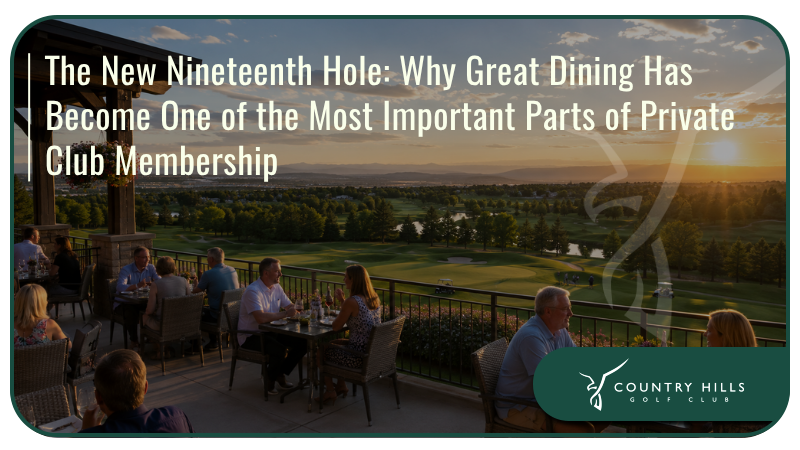
Over the past decade, outdoor dining has become one of the most sought-after amenities within private golf clubs. Members are drawn to spaces that allow them to enjoy exceptional views of the course while remaining connected to the atmosphere that makes golf unique. Watching groups approach the eighteenth green, reflecting on the highlights of the day and sharing a meal with friends has become an experience that many members value as highly as the round itself.
Unlike a traditional restaurant, a golf club patio carries a strong sense of place. Every table overlooks the course where members have just spent several hours together. Conversations naturally return to memorable shots, friendly rivalries and plans for the next round. New members are introduced to long-standing traditions, guests experience the Club’s culture firsthand and families gather in an environment that feels relaxed, welcoming and distinctly different from any other dining destination.
For many private clubs, the patio has become one of the busiest and most valuable spaces on the property because it encourages members to extend their visit. Rather than viewing the clubhouse as a place to stop briefly before heading home, members increasingly see it as the natural conclusion to a day spent with friends, family and fellow golfers.
Beyond the Eighteenth Green
The golf course creates experience. The clubhouse allows members to relive it together.
Culinary Excellence Has Become Part of the Club’s Identity
Food has always been part of private club life, but the expectations surrounding clubhouse dining have changed dramatically. Members today compare every dining experience with the restaurants they visit while travelling, the neighbourhood establishments they frequent and the hospitality they encounter at leading resorts. As those expectations have evolved, so too has the role of the clubhouse kitchen.
Today’s private clubs are investing in culinary programs that reflect the same level of care and professionalism found throughout the rest of the Club. Seasonal menus, locally sourced ingredients, thoughtfully curated wine lists and chef-inspired features have become increasingly common, not because members demand luxury for its own sake, but because dining has become an important expression of the Club’s overall standard of excellence.
Quality, however, extends well beyond the menu. Consistency is equally important. Members appreciate knowing they can enjoy an excellent breakfast before an early tee time, host clients over lunch with confidence or celebrate a family milestone knowing the dining experience will reflect the quality they associate with their Club. Reliable service, attentive staff and comfortable surroundings contribute just as much to member satisfaction as the meal itself.
The strongest culinary programs understand that they are not simply serving food. They are creating experiences that reinforce why members chose to join the Club in the first place.
Hospitality Shapes Every Visit
Hospitality is often described as exceptional service, but within a private club it represents something much broader. It influences how members feel from the moment they arrive until long after they leave. A warm welcome, familiar faces, attentive staff and an environment where members feel genuinely valued all contribute to an experience that cannot easily be replicated elsewhere.
Unlike commercial restaurants, private clubs have the opportunity to build long-term relationships with the people they serve. Staff come to know members by name, understand their preferences and anticipate their needs over time. This familiarity creates an atmosphere that feels personal rather than transactional, allowing members to relax and enjoy the Club with confidence that every visit will reflect the same high standard of care.
Hospitality also influences how prospective members perceive the Club. Guests who are welcomed warmly, enjoy attentive service and experience a vibrant clubhouse often gain a much deeper appreciation for the value of membership than they would from a tour of the golf course alone. The dining room becomes one of the places where a club’s culture is most visible because it demonstrates how members interact, how staff engage with guests and how the Club brings people together.
What Members Value Most Today
| Experience | Why It Matters |
|---|---|
| Championship golf | The foundation of membership |
| Exceptional dining | Encourages members to visit more often and stay longer |
| Hospitality | Creates memorable experiences at every visit |
| Outdoor patios | Extends the social experience beyond the round |
| Family experiences | Builds long-term relationships across generations |
| Year-round amenities | Keeps members engaged throughout every season |
| Community | Strengthens friendships and creates lasting traditions |
The strongest clubs recognize that these elements work together. Exceptional golf may attract prospective members, but it is the overall experience that encourages them to remain active as participants in Club life year after year.
The Clubhouse Has Become an Extension of Everyday Life
One of the most significant changes within private clubs has been the growing variety of reasons members choose to visit. While golf remains the common thread connecting the membership, the clubhouse now supports activities that extend far beyond the game itself.
Members increasingly meet clients over breakfast before heading to the office, hold informal business discussions over lunch or reserve private dining spaces for celebrations with family and friends. Seasonal events, wine dinners, holiday celebrations and community gatherings ensure the clubhouse remains active even when golf is not the primary focus.
This shift has changed the way clubs think about clubhouse design. Flexible dining areas, comfortable lounges and adaptable event spaces allow members to use the facilities throughout the day while supporting a wide range of activities. Rather than serving a single purpose, the clubhouse has become a place where recreation, business, family and community naturally come together.
Dining Strengthens Membership Across Generations
Private clubs increasingly recognize that successful membership extends beyond individual golfers. The strongest communities are built when spouses, children, grandchildren and guests all feel connected to the Club in meaningful ways.
Dining plays an important role in creating those connections. Family brunches, holiday celebrations, graduation dinners and birthday gatherings introduce younger generations to the traditions of the Club while reinforcing the relationships that already exist between long-standing members. Over time, these experiences become part of a family’s history, creating emotional connections that extend well beyond golf.
This broader perspective also contributes to stronger member retention. When every member of the household has a reason to visit, membership becomes woven into everyday life rather than centered exclusively on tee times. Clubs that successfully create these experiences often develop stronger communities because members view the Club not simply as a place to play golf, but as one of their favourite places to spend time together.
Industry Perspective
Yesterday: Members joined primarily for golf.
Today: Members join for exceptional golf and remain because of the relationships, hospitality and experiences that surround it.
This evolution explains why so many leading private clubs continue investing in their clubhouses. The objective is no longer simply to improve a building. It is to strengthen the experiences that define membership.
Why Country Hills Golf Club Is Investing in the Member Experience
The proposed Clubhouse Renovation Project at Country Hills Golf Club reflects many of the trends shaping today’s leading private clubs. Rather than focusing exclusively on aesthetics, the proposed vision recognizes that the clubhouse has become one of the most important places where members gather, celebrate and build lasting relationships.
The plans include an expanded upper patio overlooking the golf course and West Nose Creek Valley, enhanced dining areas, an improved kitchen, a reimagined Spike Lounge, dedicated golf simulator facilities and updated event spaces that support everything from everyday dining to larger celebrations. Collectively, these improvements have been designed to create a more welcoming, flexible and enjoyable experience for members throughout the entire year.
More importantly, the proposal reflects a philosophy that extends beyond bricks and mortar. It recognizes that every improvement to the clubhouse creates new opportunities for members to spend time together, introduce guests to the Club, celebrate important milestones and enjoy the sense of community that has always been central to Country Hills Golf Club. Rather than changing the character of the Club, the proposed renovation has been designed to strengthen the experiences that members already value while preparing the clubhouse to serve future generations.
Investing in a Clubhouse Is Really an Investment in People
When a private golf club announces renovation, the conversation often begins with architecture. Members naturally want to know what the new dining room will look like, how the patio will be expanded or what amenities will be added to the clubhouse. Those questions are important, but they only tell part of the story.
The true measure of a successful renovation is not found in construction drawings or square footage. It is reflected in how the building improves the everyday experiences of the people who use it. A thoughtfully designed clubhouse creates opportunities for members to spend more time together, welcome new families, celebrate important milestones and enjoy the sense of community that has always distinguished private clubs from other recreational facilities.
Every improvement should make the Club easier to enjoy. Better dining spaces encourage members to stay after their rounds. Comfortable lounges create natural gathering places throughout the day. Flexible event areas allow the clubhouse to host celebrations, educational events, holiday gatherings and charitable functions that strengthen relationships across the membership. Outdoor patios invite members to slow down, enjoy the setting and remain connected to the Club long after golf has finished.
Viewed through this perspective, a clubhouse renovation becomes far more than a capital project. It represents an investment in the experiences that members will share over the next twenty or thirty years and the traditions that future generations will inherit.
From Facilities to Experiences
| Traditional Approach | Modern Private Club Vision |
|---|---|
| Improve the building | Improve the member experience |
| Focus on golf operations | Balance golf, hospitality and community |
| Separate dining from golf | Integrate dining into the overall Club experience |
| Seasonal clubhouse activity | Year-round member engagement |
| Functional gathering spaces | Flexible spaces that adapt throughout the day |
| Short visits | Members spend more time at the Club |
| Clubhouse supports golf | Clubhouse strengthens the entire membership experience |
The most successful clubhouse projects begin by asking a simple question. How can this space help members enjoy the Club more often and in more meaningful ways? When that question guides every design decision, the renovation becomes an investment in people rather than simply an investment in infrastructure.
Why This Matters for Country Hills Golf Club
The proposed Clubhouse Renovation Project at Country Hills Golf Club reflects this broader evolution within the private club industry. Earlier this season, members voted in favour of advancing the next phase of the project, allowing the Club to continue developing architectural renderings and refining a comprehensive vision ahead of a final membership vote. If approved, the renovation will be funded through a combination of the Club’s Capital Reserve Fund and bank financing, demonstrating a long-term commitment to responsible stewardship while investing in the future of the Club.
The proposal focuses on creating spaces that support the way members use the Club today while remaining flexible enough to serve future generations. Expanded dining areas, a reimagined Spike Lounge, an enhanced kitchen, dedicated golf simulators, improved event spaces and a significantly larger upper patio overlooking the golf course and West Nose Creek Valley have all been designed to strengthen the overall member experience rather than simply modernize the building.
These improvements align with the broader direction of the private club industry. Members increasingly expect their club to provide exceptional hospitality alongside outstanding golf, creating opportunities to gather with friends, enjoy memorable dining experiences, introduce family members to the Club and remain connected throughout every season of the year.
How the Proposed Renovation Supports Today’s Member Expectations
| What Members Value Today | Proposed Country Hills Vision |
|---|---|
| Exceptional dining | Expanded dining room and enhanced kitchen |
| Outdoor gathering spaces | Expanded upper patio overlooking the golf course and West Nose Creek Valley |
| Comfortable social spaces | Reimagined Spike Lounge |
| Year-round golf | Dedicated indoor golf simulators |
| Family celebrations | Improved banquet and event facilities |
| Hospitality | Operational improvements designed around the member experience |
| More reasons to visit | Flexible spaces that support dining, events and community throughout the year |
Rather than introducing amenities for the sake of change, the proposal reflects a thoughtful response to how members already enjoy the Club and how those expectations continue to evolve.
Looking Ahead
Private golf has always been about more than eighteen holes.
It is about friendships that grow stronger over decades, traditions that are passed from one generation to the next and communities that celebrate life’s most important moments together. Golf provides common interest, but it is often the clubhouse that creates lasting memories.
Members may remember a well-played round for a season, but they remember championship dinners, family celebrations, holiday gatherings and evenings on the patio for a lifetime. Those experiences shape how people feel about their Club because they become part of the stories members share with one another year after year.
As private clubs continue to evolve, the most successful organizations will be those that understand this distinction. They will continue investing in spaces that encourage connection, strengthen hospitality and create reasons for members to spend more time together. Golf will always remain the foundation, but the experiences surrounding the game will increasingly define the value of membership.
Country Hills Golf Club’s proposed Clubhouse Renovation Project reflects that philosophy. It honours the traditions that have shaped the Club while creating opportunities for future generations to enjoy exceptional golf, outstanding hospitality and a vibrant clubhouse that remains at the centre of member life throughout every season.
Final Thoughts
The finest private golf clubs have never been defined solely by their golf courses. They are remembered for the communities they build, the traditions they preserve, and the experiences that bring people together year after year. Dining has become one of the clearest expressions of that philosophy because it creates opportunities for members to slow down, reconnect and enjoy the Club in ways that extend well beyond the game itself.
The proposed Clubhouse Renovation Project at Country Hills Golf Club reflects that long-term vision. By investing in hospitality, dining, year-round amenities and thoughtfully designed gathering spaces, the Club is preparing for the next chapter of its history while remaining true to the values that have made it one of Calgary's premier private golf clubs. The result is not simply a renovated clubhouse, but a stronger foundation for the friendships, celebrations and traditions that will continue defining Country Hills Golf Club for generations to come.